Since 1 October 2026 In Austria, the following applies: Network and Information Systems Security Act 2026 (NISG 2026). Austria is thus implementing the European NIS 2 Directive and provides for the establishment of a body subordinate to the Federal Ministry of the Interior Federal Office for Cyber Security . For many businesses in Tyrol – from a craft business in Hall to a service provider in Innsbruck – the same question arises: Are we affected, and what exactly do we need to do now?
This article summarises publicly available information from the authorities and translates it into a practical checklist. It is not a substitute for legal advice. If you are unsure, please check the latest information on the USP and Federal Office websites, or seek specialist advice.
What has changed since 1 October 2026
According to the Business Service Portal (USP), the NISG 2026 will bring into force requirements aimed at raising cybersecurity standards. At the same time, the USP is implementing the application „NIS 2 Services“ ready. Affected organisations can find out more about this register and report significant cyber security incidents.
Important: The timely submission of notifications will be mandatory once the Act comes into force, and will be possible from that point onwards. Registration is therefore only one part of the obligations – the security and organisational requirements already apply to the organisations covered.
Who is subject to these obligations
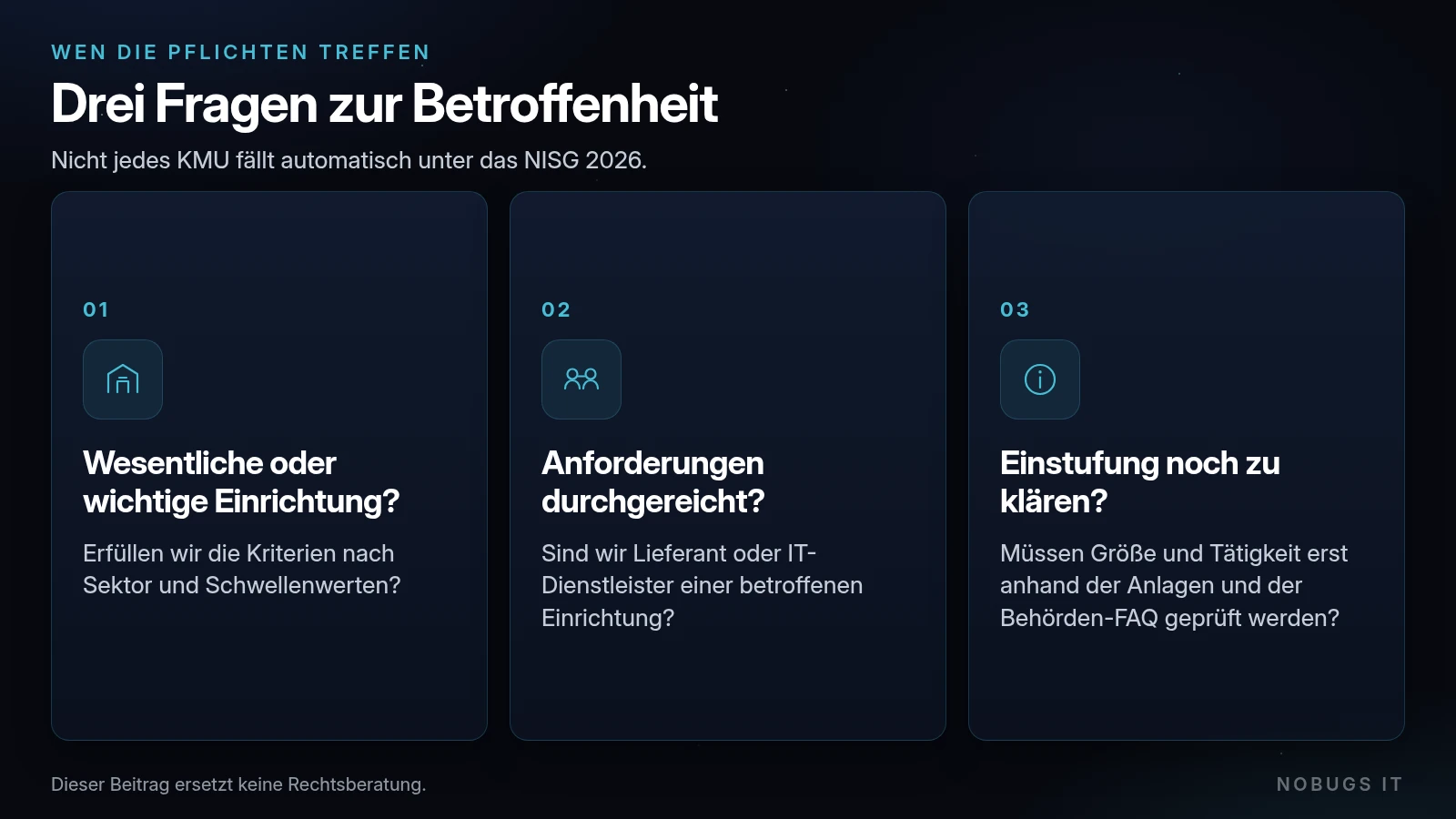
The NISG 2026 is aimed at essential and key facilities in certain sectors and size categories. Not every SME in Schwaz, Wattens or Jenbach automatically falls into this category. In practice, three questions can help:
- Do we meet the criteria for a significant or important institution (sector and thresholds)?
- Are we a supplier or IT service provider to an affected organisation, and are requirements „passed on“ to us under the terms of a contract?
- Do the size and nature of the activity first need to be clarified on the basis of the statutory annexes and the authorities’ FAQs?
The Federal Office for Cyber Security points out that third-party ICT service providers, which are also covered by DORA, must register under the NISG 2026, if they meet the criteria as a key or important organisation – for example, as a medium-sized or larger managed service provider. According to the FAQs, critical organisations under the RKE Act are also regarded as key organisations under the NISG 2026 and must register, provided they have not already done so.
Registration via the USP
According to the USP, the initial registration is due by 1 January 2027 to take place. The Federal Office’s FAQs (last updated 30 October 2026) specify, for organisations that were already registered on 1 October 2026, the period beginning on 1 October 2026 and ending no later than 31 December 2026. You should therefore plan your registration well in advance and check the current deadlines on the government websites in case the information differs.
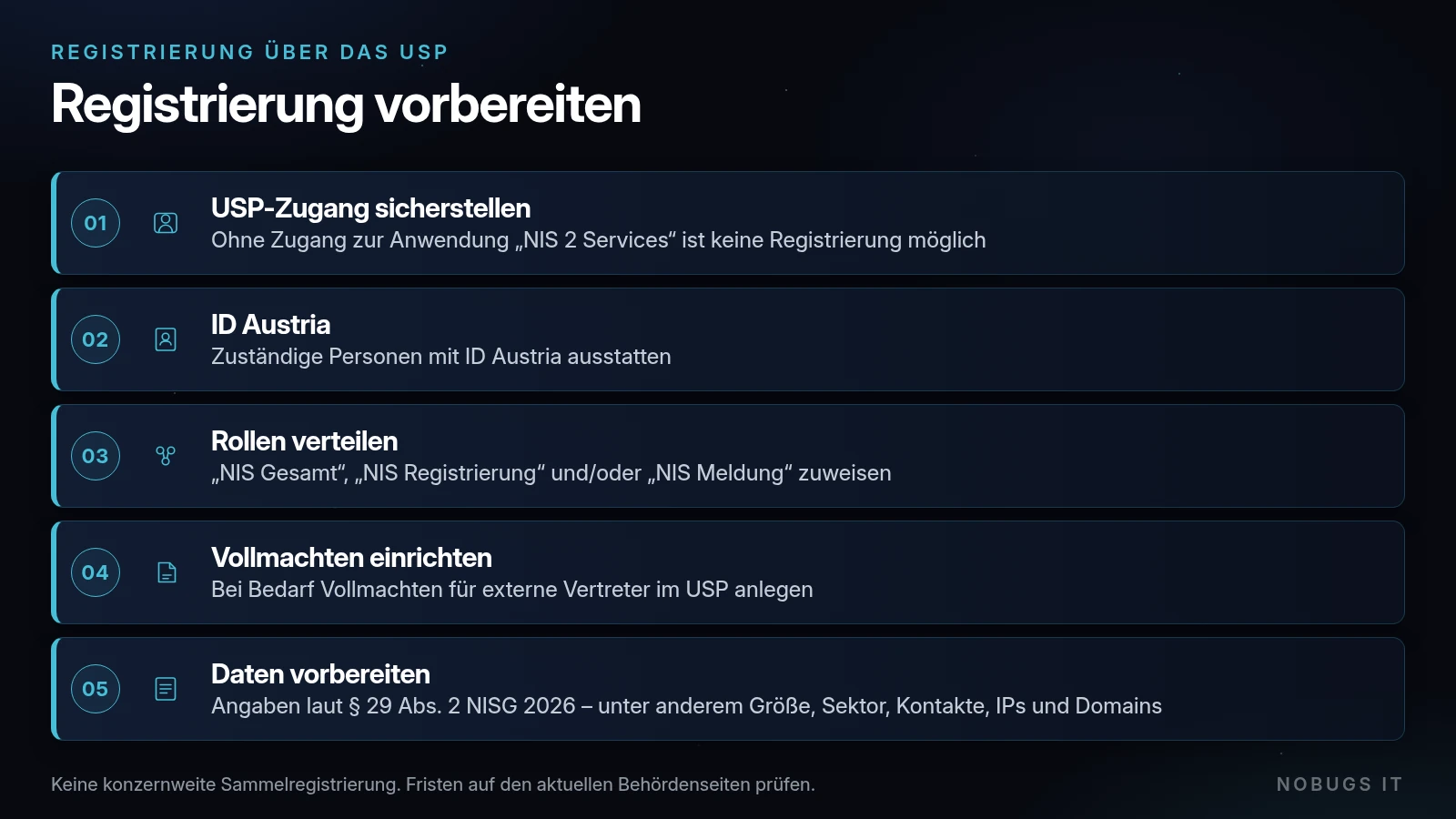
Preparation according to the USP:
- Ensure access to the USP.
- Responsible persons with ID Austria equip.
- Assign roles: „NIS Overall“, „NIS Registration“ and/or „NIS Notification“.
- Where necessary, draw up powers of attorney for external representatives.
- Prepare data in accordance with Section 29(2) of the NISG 2026 – in particular, company size as defined in Section 25.
The information to be provided includes, amongst other things, name, address and contact details, sector(s) and type of organisation, EU Member States in which services are provided, and, where applicable, static public IP address ranges (according to the Federal Office, this may be supplemented by domain names/URLs), the address of the head office, and details of the thresholds and classification.
According to the Federal Office, there are no plans for a group-wide collective registration; each affected institution must register itself. However, authorised persons may register multiple institutions with the USP.
Sanctions: According to the Federal Office, if key or important organisations fail to comply with the registration requirement, they face fines of up to EUR 50,000, and in the event of a repeat offence, up to EUR 100,000 (Section 45(4) of the NISG 2026).
Reporting requirements and IT practices for Tyrolean businesses
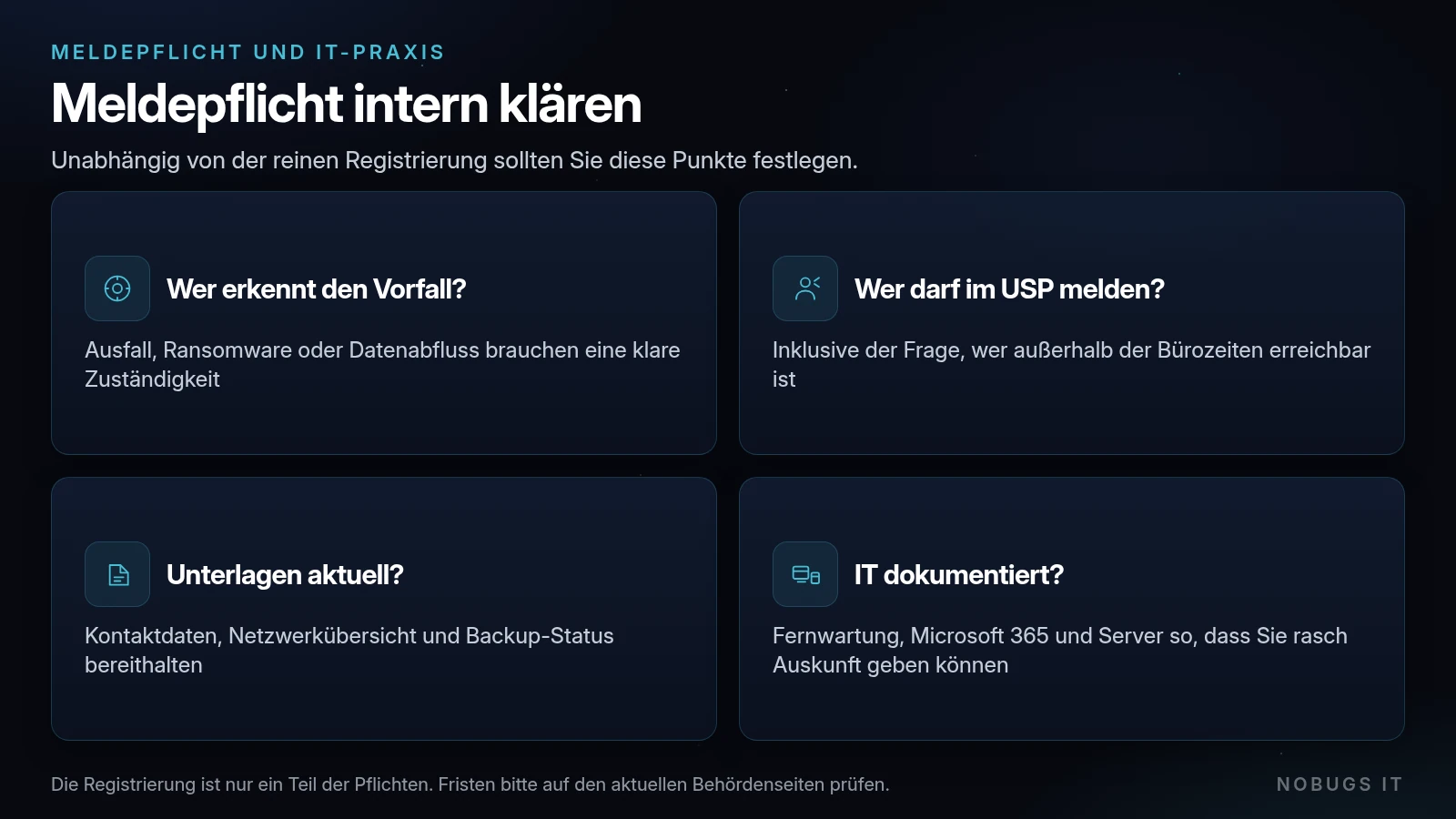
Apart from the registration itself, you should clarify the following internally:
- Who identifies a significant incident (outage, ransomware, data breach)?
- Who is authorised to report incidents via the USP – and who can be contacted outside office hours?
- Are the contact details, network overview and backup status currently up to date?
- Are remote maintenance, Microsoft 365 and servers documented in such a way that you can provide information quickly?
In the Innsbruck–Schwaz–Jenbach region in particular, many businesses operate on a hybrid model: on-site offices, field staff and cloud services. Clear lines of responsibility and a well-maintained IT inventory are more helpful than a one-off PDF checklist.
The USP also warns against dubious „NISG impact assessments“ on the internet, which may result in sensitive company data being disclosed. Please use official sources and check the legal notice and service promises.
Checklist (short)
- USP access and ID Austria available
- Assign the „NIS Registration“ / „NIS Notification“ roles
- Sector, size and classification checked
- Static public IP addresses and domains listed
- Definition of an internal incident report
- IT documentation and contact details kept up to date
- Registration with the USP has been completed or an appointment has been made
Frequently Asked Questions
Do all Tyrolean SMEs have to register?
No. The registration requirement applies to key and important organisations. Many SMEs are not directly covered, but may be contractually involved as suppliers.
Is registration alone sufficient?
No. Security, organisational and reporting obligations have applied to registered establishments ever since the legislation came into force.
Can we authorise an IT partner?
Yes. According to the USP, proxy arrangements or powers of attorney are permitted under the USP where third parties are to act on behalf of the institution.
NOBUGS IT GmbH supports companies in Innsbruck, Schwaz, Hall, Wattens, Jenbach and support with technical preparations: inventory, security measures, documentation and practical incident management processes – tailored to your Microsoft 365 and server environment.
Sources
- https://www.usp.gv.at/aktuelles/newsliste/NIS-2.html
- https://www.bundesamt-cybersicherheit.gv.at/faq/registrierung.html